Free Pest Control Receipt Generator
This free pest control receipt maker lets you add your logo, your company and client details, treatment line items, tax or VAT, and your currency, then save the finished receipt as a PDF or PNG or print it, with no account needed.
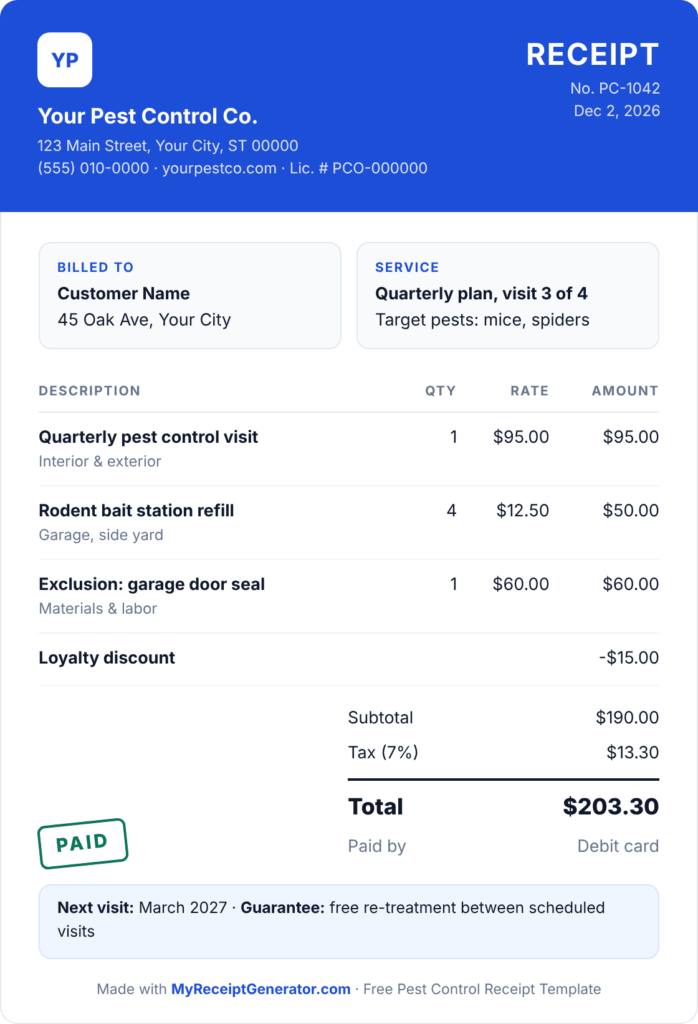
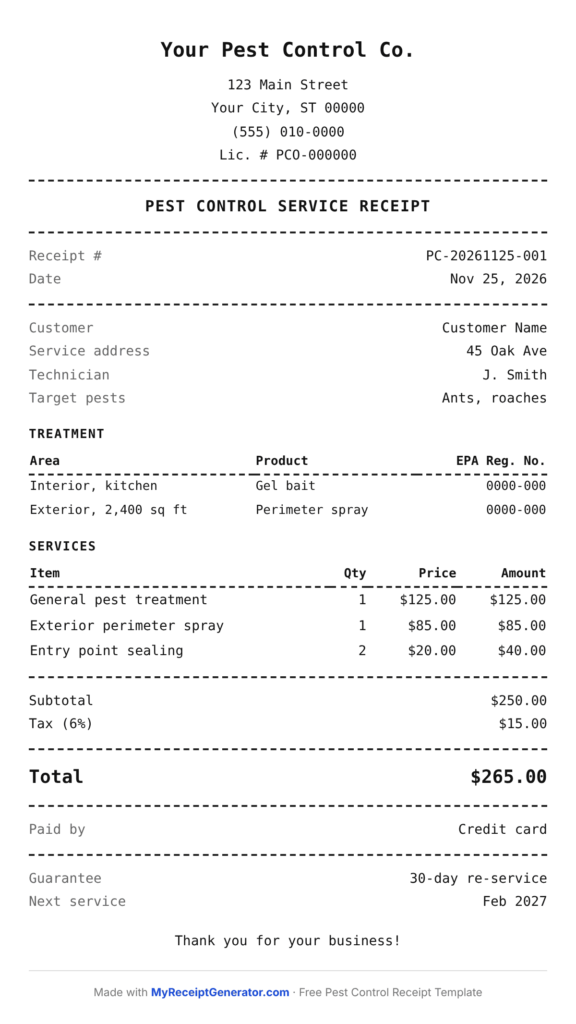
A pest control receipt is a dated document showing that a customer paid for a treatment. A complete one lists the company’s license number, the pests and treatment areas covered, each product applied with its EPA registration numbers, the warranty terms, the amount paid, and the payment method. The form on this page has room for all of it.
For customers, the receipt is the only proof of service they hold once the truck leaves the driveway, and it’s the first thing they dig out when the roaches come back. In the receipts I’ve reviewed for service businesses, the companies with the fewest arguments over repeat visits are the ones that issue a detailed receipt on every job, not only on the big termite contracts.
Every receipt you make here is free to download, with no sign-up, no watermark, and no paid upgrade. Complete the form above, then use the guide below to make sure nothing important is missing. You can also browse all our receipt templates for other trades.
What Can You Add With This Pest Control Receipt Generator?
This pest control receipt generator covers everything a treatment receipt needs: your business and logo, the customer and service address, itemized treatment lines with quantities and unit prices, a discount line, tax or VAT, currency, the receipt date, and a free-text comments field.
Treatment lines matter more than design options. Listing interior work and exterior perimeter treatment as separate lines tells the customer exactly where product went, which a single “general treatment” line never does.
The math is handled for you. The generator calculates each line from the quantity and unit price, then applies the tax rate you set, so a mistyped sum doesn’t slip onto a receipt the customer keeps for years.
Currency is a simple choice in the form. Pick USD for American jobs or CAD for Canadian ones, which matters if your routes cross the border.
The form is fully customizable, and the work comes down to three steps: your details, the treatment lines, and the finished file. If you also bill before treatment, use the same business details on your bills so client invoicing and receipts always match.
How Do You Use This Pest Control Receipt Generator?
To use this pest control receipt generator, add your business and the customer, list each treatment as its own line, set the tax rate and currency, date the receipt, check it, and then save or print it.
In this online receipt maker, the whole process rarely takes more than a few minutes.
- Business info goes in first: upload your logo, then add your business name, phone number, and website, followed by the customer’s name and service address. Replace any example values in the fields with your own data.
- Editable line items come next. Give each treatment, product, and visit fee its own row with a quantity and unit price, and add a separate line for any discount, so the itemized charges read as clearly as they would on an itemized receipt.
- Preview the receipt after setting the tax or VAT rate, currency, receipt date, and comments. Read it the way the customer will.
- Download the receipt as a PDF or PNG, or print it from your browser, and send it right after payment.
Need a JPEG instead? Open the PNG in any image editor and save it in that format; the receipt looks identical.
The generator works with no signup required, which is handy when you’re standing in a client’s driveway with a phone. For very high volumes, software that can automate receipts from completed jobs is worth a look too.
Why Does a Pest Control Business Need to Give Receipts?
A pest control business needs to give receipts because each receipt is the company’s own evidence of what was treated, with which products, and under which terms, and that evidence matters in a complaint or an audit as much as the payment does.
Most people assume receipts exist for the customer’s benefit. In practice, pest management companies lean on them harder than anyone, because a receipt listing the target pests and the treatment methods used is what settles things when a client insists the ants were never dealt with.
The service guarantee printed on a pest control receipt does similar work. When the guarantee wording and the customer’s signature lines sit on the same page, there’s very little room later for “nobody told me the garage wasn’t covered.”
Pest control receipts also travel well beyond the job site. Property managers and business tenants attach them to expense reports and claim reimbursements from owners or head office, so one vague receipt can hold up somebody else’s paperwork for weeks.
A caution that template sites print themselves: their sample receipts are labelled as a fictional example, not evidence that anyone paid. A filled-in demo never replaces a real, dated pest control receipt tied to an actual visit.
What Details Belong on a Pest Control Receipt?
A pest control receipt should carry the company’s identity and license, the client information, the treatment specifics, an itemized money section, and a payment line that confirms the job is settled.
It helps to think of the pest control receipt in layers rather than as one long list of fields. Each layer answers a different reader: the customer checking the work, the regulator checking the chemistry, and the bookkeeper checking the math.
- Pesticide products: name each product applied, together with the application rates, because most states already expect operators to hand customers that treatment detail.
- Subtotals: show separate subtotals for labor and products, then any discounts and customer tips, so every step of the arithmetic is visible.
- Invoice numbers: reference the matching invoice numbers, so a receipt and its bill can be paired in seconds during a disagreement or an audit.
When people fill in a pest control template, the money section tends to get careful attention while the treatment section gets rushed. I’d flip that priority. The treatment lines are what a regulator, a home inspector, or an unhappy customer reads first. The generator above has space for every one of these details, using its line items and comments field.
Which Pest Control Receipt Template Fits Your Service?
The right pest control receipt template is the one whose fields match the pest type you treated and the way the visit was scoped, not whichever design looks cleanest.
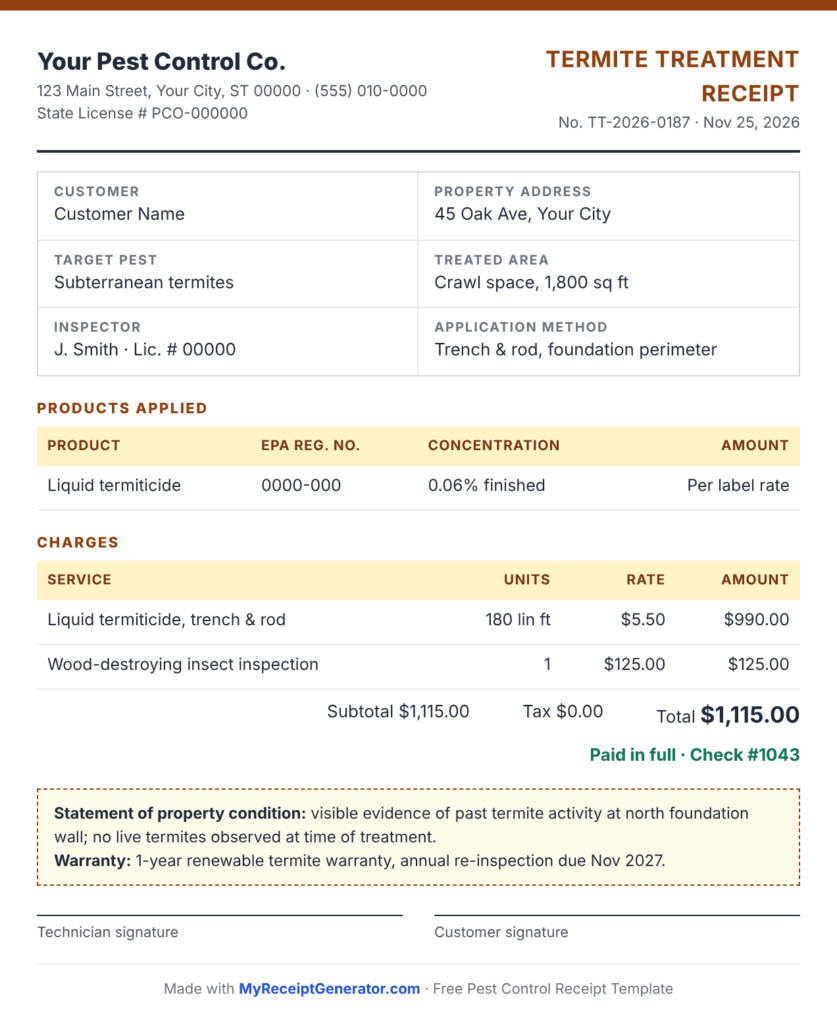
Before you pick a template or set up this one, list the details your technicians actually write down on a typical job. Exterminators doing wood-destroying insect work need room for a termite inspection note and the areas checked, while a crew handling rats and mice needs space for bait stations and sealed entry points.
Jobs that run inside and outside a building need separate zone lines, and any job involving chemicals needs room for product names. A template with one blank description box forces all of that into a sentence nobody will read. The same rule holds for any service receipt: an HVAC receipt or a plumber receipt needs different fields from a pest job for exactly this reason.
Recurring contracts deserve their own layout too. When a client is on a yearly agreement, the receipt should show which scheduled visit this was and whether it was a callback, so you can see at a glance how often a property needs repeat attention.
When Should You Send a Pest Control Receipt?
You should send a pest control receipt as soon as the customer pays, and in any case within 24 hours, so the payment and the visit are documented while both are fresh.
The timing rule applies to every payment, not only the final one. When an invoice is settled in stages, each payment gets its own payment receipt, and the last one should be clearly marked paid so nobody chases a balance that no longer exists.
Clients on an annual service plan are where timing slips most. I’ve seen companies send one receipt at renewal and nothing after individual visits, which leaves the customer with no treatment record for the months in between. That’s exactly what a rodent control client needs when droppings reappear.
Before sending, check that the customer name matches the booking and that the total matches what was charged. Enter the payment date rather than the visit date when the two differ.
A short thank-you message at the bottom costs nothing. Customers keep the receipt as proof of purchase, and a polite closing line makes it more likely they’ll call you, not a competitor, next season.
How Do You Keep Pest Control Receipts Accurate?
Pest control receipts stay accurate when each one carries a unique receipt number, a correct transaction date, and a clear statement of which part of the bill it settles.
Numbering is easiest when receipts and bills follow one sequence, and an invoice number generator keeps that sequence clean from the first job.
Two dates cause most of the confusion I come across. The service date is when the technician treated the property; the transaction date is when the money arrived. On prepaid or delayed jobs the two differ, and mixing them up turns a simple dispute into a he-said, she-said.
Cash payments and partial payment receipts need extra care, because there’s no bank trail to fall back on, so use a proper cash receipt format rather than a scribbled note. Write down the amount received and the balance left, and keep a duplicate for your own files.
A dynamic barcode that links a printed receipt back to its source file makes a lost receipt easy to reissue, and you can create one with our free barcode generator.
Accuracy is also a workflow question. When the same person who requests payment also writes the receipt, mistakes repeat unnoticed. A quick second check, and the habit of organizing by year from the first day, catches most errors before a customer does.
What Are Pest Control Receipts Used For?
Pest control receipts are used to prove payment, support deductions and claims, back up property sales, and give both the operator and the customer a dated history of every treatment.
On the customer side, a general pest control receipt is usually filed and forgotten until it’s needed. Landlords pull them out to show tenants the building is maintained, and facilities teams at commercial sites use them to prove a contractor actually visited.
For multi-location clients, such as a restaurant group, receipts sorted by client or property show which branch generated which service charges. In my experience, that is the first question their finance team asks.
The notes field earns its place in real estate transactions. A buyer’s agent who sees a note about earlier treatment, with zero amount owed, knows the work was settled and can ask informed questions about the house’s history.
What Is the Difference Between a Pest Control Receipt and an Invoice?
A pest control invoice asks the customer to pay, while a pest control receipt confirms that payment already happened and serves as written proof of it.
The confusion usually comes from businesses that send the same document twice with a different title on top. A pest control invoice lists the total cost, the materials used, and the payment terms. The receipt should mirror those lines, then state what each payment covers. If you bill before treatment, start from one of these invoice templates so both documents share the same layout.
| Point | Pest control invoice | Pest control receipt |
| Purpose | Requests payment for the job | Confirms payment was received |
| When it’s sent | Before the customer pays | After the customer pays |
| Status shown | Lists what is still owed | Marked “paid” |
| Works as proof of payment | No | Yes |
When a job is settled in one go, a single receipt for the full payment closes the file. When it’s settled in installments, the invoice stays open and each receipt chips away at it, which is why the receipt needs to say what it covers.
How Long Should You Keep Pest Control Receipts?
You should keep each pest control receipt for at least the full period your country’s tax authority can review the return it supports, and longer if a termite warranty or later service claim could still depend on it.
Pest control receipts run on two clocks at once. The tax clock is fixed by law, and the country-by-country periods are set out in the filing table in the next section. The warranty clock is set by your own guarantee, and on long termite contracts it can outlast the tax one.
Keep original copies alongside digital copies, and never let one folder on one device be your only record. A downloaded PDF backed up in two places survives a lost phone or a failed laptop.
Where a receipt includes a statement of property condition, as termite paperwork for home sales often does, keep it for as long as anyone might rely on it.
Combine that with sequential numbering and money running through a separate business bank account, and your receipts double as tax documentation and a ready-made budget tracking history.
How Should You Organize and File Pest Control Receipts?
You should file pest control receipts by year first, then by client or property, and keep each year’s folder until the retention period for the country where you file has passed.
Retention clocks start at different moments in different countries, and that’s where most filing systems quietly break. Some count from the day you file, some from the end of the tax period, and one counts from the filing deadline itself.
| Country | How long to keep receipts | When the clock starts |
| U.S. | Three years | The filing date of the return |
| Canada | Six years | The end of the tax year |
| UK | Five years | The submission deadline for that tax year |
| Australia | Five years | Lodging the tax return |
These periods are general minimums, so confirm them with your accountant before shredding anything. U.S. businesses can read the full rules in the IRS recordkeeping guidance. Specific situations, such as an open audit, can stretch the period.
A practical filing habit: name each digital file with the year, client, and receipt number, then mirror that structure in your paper folders. When a customer calls years later, you’ll find the right receipt in under a minute. Once your folders are set up, make the next receipt with the generator at the top of this page and file it straight into place.
Pest Control Receipt FAQs
Is This Pest Control Receipt Generator Free?
Yes, this pest control receipt generator is completely free, with no account, sign-up, or paid plan, and every download is clean and ready to send. It works the same way as all the pest control receipt templates and other receipt formats on this site. The form covers business and customer details, treatment lines, tax or VAT, and the common export formats, so you can finish a receipt in one sitting. If your state taxes pest services, the free sales tax calculator helps you check the figure, and the receipt generator guide walks through setup step by step. Before your first real job, make one test receipt and open it on your phone to make sure it prints cleanly.
What Must a Pest Control Receipt Include at Minimum?
At minimum, a pest control receipt must show the company name, contact details, and state pest control license number, plus the customer, the service date, what was treated, the amount paid, and how it was paid. Adding the technician name takes a few seconds and pays off when a customer asks who treated their home. The license number also lets customers verify the business with the state. Anything beyond this minimum, such as warranty terms or product names, makes the receipt more useful in a complaint, so treat the minimum as a starting point rather than a final target.
Do States Require a Pest Control Treatment Record?
Yes, most states require pest control operators to give customers a treatment record that lists the pesticide products, their EPA registration numbers, and the application rates. For regulatory compliance, the safest approach is to treat chemical applications as line items on the receipt, naming each of the chemical products, the application method, and the concentration. Termite work tied to a property sale may also need the inspector’s license number. You’ll find each number printed on the product label, and the EPA’s guide on how to read a pesticide product label shows exactly where. Rules differ from state to state, so check your state’s pesticide regulator. Keeping these details on the receipt itself means the customer never has to ask for a separate report.
What Termite Receipt Do Real Estate Transactions Need?
Real estate transactions often need a termite inspection and treatment receipt that includes the inspector’s license number and a statement of property condition. Beyond that, buyers and lenders look for documentation tied to the exact property address, the areas covered such as the crawl space, the treated square footage, and whether termite treatment was carried out or only recommended. Sellers who kept tidy receipts from earlier visits tend to answer these questions in a single message. Sellers without that paperwork often end up paying for a fresh inspection just to recreate a history they could have handed over in minutes.
Which File Formats and Currencies Does This Pest Control Receipt Generator Support?
This pest control receipt generator downloads receipts as PDF or PNG, prints straight from your browser, and lets you choose your currency, including USD and CAD. A printable PDF is the safest default because it looks the same whether you email it, hand it over as a printed handout, or send it by mail. The PNG suits quick sends by text message. For customers who prefer paper, print the PDF rather than the image file, since PDFs keep text and table lines sharp at any print size. Whichever format you pick, keep a copy in your own files before sending.
Can You Add Your Logo to This Pest Control Receipt?
Yes, you can upload your business logo for free, and this pest control receipt generator places it at the top of the receipt. A custom logo carries your brand colors onto every receipt, which does more for a small pest business than custom styling ever will. If you already run pest control software or invoicing software, upload the same logo here so receipts match the rest of your estimate-to-receipt process; you only need to edit the file once. A consistent logo also makes altered copies easier to spot, because regular customers know what a genuine receipt looks like. A QR code linking to your website adds one more way for customers to confirm the receipt is yours.