Most taxi rides end the same way. The card machine beeps, the driver asks if you want a receipt, and half the time the printer is out of paper.
Then you get to your expense report, and the finance team wants the fare broken down. Not a total. The base fare, the distance charge, the tolls, the tip, each on its own line.
This page covers what a taxi receipt has to show, why a card statement will not do, and how to produce one in about a minute.
Why a Taxi Receipt Is Harder Than It Looks
A shop receipt lists what you bought. A taxi receipt has to explain how a number was arrived at.
The fare is not one price. It is a base charge, plus a rate per mile or kilometre, plus time spent waiting in traffic, plus whatever surcharges applied at that hour, plus tolls the driver paid on your behalf. Finance teams know this, which is why a single total gets bounced back.
Three groups need the document, for different reasons.
Passengers claiming expenses. Ground transport is one of the most rejected categories on expense reports, usually because the receipt shows a total with no breakdown or no date.
Drivers and operators. Every fare is declarable income. A receipt book, digital or paper, is what stands between you and reconstructing a year of cash rides from memory.
Anyone chasing a lost bag. In New York, the medallion number on your receipt is how the Taxi and Limousine Commission identifies which cab you were in. The TLC tells passengers directly to take the receipt for exactly this reason, since without the medallion or the driver’s licence number a lost item is almost impossible to trace.
What a Taxi Receipt Must Include
Work down this list. Anything missing from the first group tends to get an expense claim returned.
- Company or operator name, plus a logo if you have one
- Driver name or driver licence number
- Vehicle identifier, which is the medallion number in New York, the plate elsewhere
- Date of the trip
- Pick-up time and drop-off time
- Pick-up address and destination
- Distance travelled, in miles or kilometres
- Base fare, on its own line
- Distance charge, showing the rate and the amount
- Total fare
- Payment method, and the last four digits if a card was used
- Receipt number, unique and sequential
Then the charges that only appear on transport receipts. Each one belongs on its own line:
- Wait time or time-in-traffic charge
- Tolls and bridge fees
- Airport pickup or drop-off surcharge
- Night, weekend, or peak surcharge
- Congestion or clean-air levy
- Luggage or extra passenger fee
- Booking or dispatch fee
- Tip
Never fold a toll into the fare. Tolls are frequently reimbursed under a different budget line from the fare itself, and a finance team that cannot separate them will ask you to.
Why the Card Statement Is Not Enough
This is the single most common reason a transport claim gets held up.
Your bank statement says something like “CITY CAB CO 34.20.” It proves money left your account. It does not show the date of travel, where you went, how far, or whether the total included a tip. None of the things an approver actually checks.
The same applies to the app confirmation on your phone. An in-app trip summary is useful, but many finance systems want a document with the operator’s name and contact details on it, not a screenshot.
If you have lost the original, do not submit the statement and hope. Rebuild the receipt with the real trip details, mark it clearly, and attach the statement as supporting proof of payment. That is a records gap being documented honestly, which is a different thing from inventing a journey.
Taxi Receipt Format
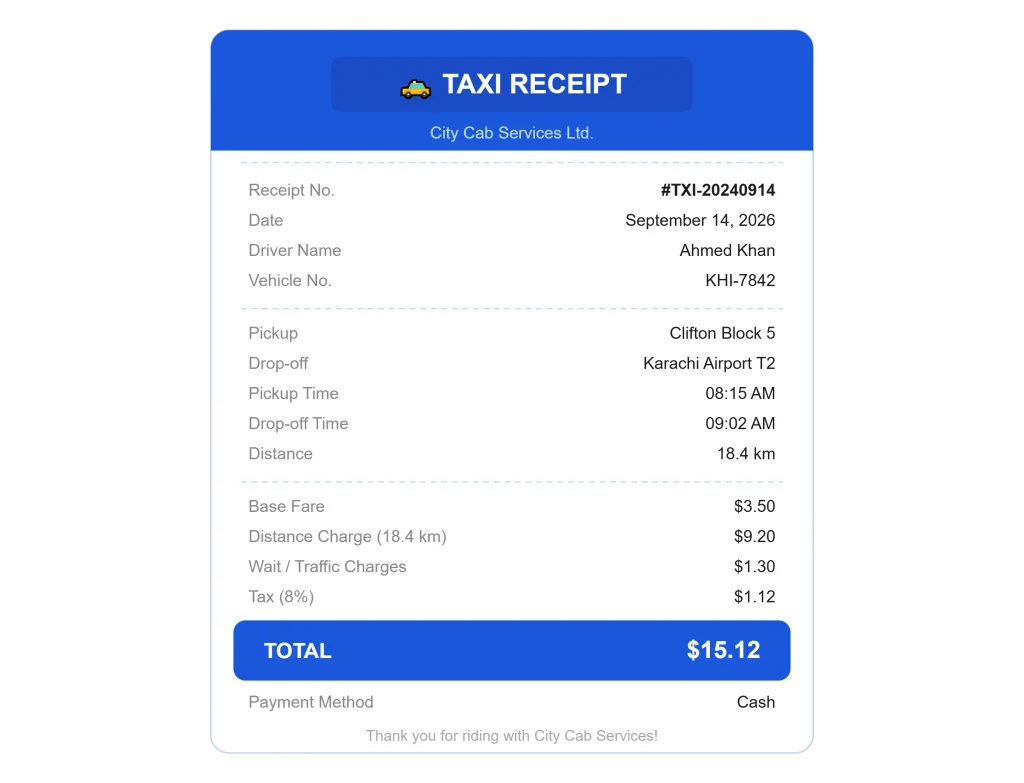
This is the layout the tool produces. Quantities and rates are visible, so nobody has to ask how the total was reached.
CITY CAB CO.
Licence #TC-12345
55 Station Road, Anytown
———————————
Receipt # A-2980
Date 12 Sep 2026
Driver M. Idrees
Vehicle TC-2241
———————————
Pickup 14:05 Airport T2
Dropoff 14:38 Downtown
Distance 14.2 mi
———————————
Base fare 3.50
Distance 14.2 @ 2.00 28.40
Wait time 6 min 2.40
Airport surcharge 5.00
Toll 6.50
———————————
Subtotal 45.80
Tip (15%) 6.87
———————————
TOTAL 52.67
Visa ••4291
Make a Taxi Receipt in Six Steps
- Enter the operator details. Company name, licence or base number, address, phone. Set these once, and they carry over.
- Add the driver and vehicle. Driver name or licence number, plus the medallion or plate. Corporate travel policies increasingly ask for both.
- Fill in the trip. Date, pick-up and drop-off times, both addresses, and the distance.
- Break down the fare. Base fare on one line, distance charge on another with the rate visible, then wait time, surcharges, and tolls as separate lines.
- Add the tip separately. Never bundle it into the fare. Reimbursement rules often cap gratuity at a percentage, and an approver has to be able to see it.
- Download. PDF for an expense system, PNG for a quick reimbursement message. Or send it straight to the passenger on WhatsApp or by email.
For Drivers and Operators
If you drive a licensed cab, run a private hire car, or manage a small fleet, the receipt is your accounting record before it is anything else.
Number them sequentially. A gap in the sequence is the first thing an accountant notices. If you need a format to stick to, the invoice number generator will build one.
Issue at the end of the trip, not at the end of the week. A stack of receipts written on Sunday for rides taken on Tuesday has identical formatting, consecutive numbers, and no relationship to when money moved. It reads exactly as it is.
Show the rate, not just the amount. “Distance 14.2 @ 2.00” answers a question that “Distance charge 28.40” invites.
Keep your own copy of every one. Retention periods run three to seven years in most countries. The record-keeping guidance on GOV.sets out the UK rules for self-employed drivers, including what counts as an acceptable digital record.
What Different Journeys Need
Not every trip carries the same fields.
| Trip type | Add these lines |
| Airport run | Pick-up terminal, airport surcharge, tolls |
| Long-distance | Fixed or agreed fare instead of a metered rate |
| Pre-booked private hire | Booking reference, dispatch fee |
| Hourly hire | Hours engaged and the hourly rate, no distance line |
| Shared or pooled ride | Your share, plus a note that the fare was split |
Mistakes That Get Transport Claims Rejected
One line saying “taxi fare.” No date, no route, no breakdown. An approver cannot verify anything from it.
Missing the date of travel. Surprisingly common on handwritten receipts, and it makes matching the claim to a trip impossible.
Tip folded into the total. Many policies reimburse gratuity separately or cap it. Bundled, the whole line gets questioned.
No operator identification. A receipt with no company name, licence number, or plate could describe any journey at all.
Rounding the fare up. If the meter read 34.20, write 34.20. A receipt that ends in a round number when the meter never does invites a second look.
Rebuilding a ride that did not happen. Adding a plausible airport run to top up a claim is expense fraud. Detection software flags round numbers, duplicate routes, and unusual patterns far more reliably than people expect.
Frequently Asked Questions
Can I use my bank statement instead of a taxi receipt?
Rarely. A statement proves payment left your account but shows no date of travel, no route, no distance, and no fare breakdown. Most policies require the receipt itself, with the statement acceptable only as supporting evidence.
What is a medallion number and do I need it?
It is the licence number identifying a specific cab, used in New York and some other cities. The TLC advises passengers to keep the receipt because the medallion number is how a lost item or a complaint gets traced to the right vehicle. Outside those cities, the plate or vehicle licence serves the same purpose.
Does a taxi receipt need the driver’s name?
Not always by law, but many corporate travel policies ask for the driver’s name or licence number alongside the vehicle identifier. Include both if the passenger is claiming the fare back.
Should the tip be on the receipt?
Yes, as its own line. Reimbursement policies commonly cap gratuity at a set percentage, and an approver needs to see the fare and the tip separately to apply that rule.
What if I lost the original receipt?
Ask the operator first, since licensed companies keep trip records and many will reissue. If they cannot, rebuild the receipt with the actual trip details and attach your card statement as proof of payment. Check your employer’s policy, because some will not accept a reissued receipt for ground transport.
Is a digital taxi receipt valid?
In most countries, yes. Electronic records are generally accepted provided they are accurate, complete, unaltered, and retrievable for the required retention period. Check your national tax authority for the rules that apply to you.
How long should a driver keep fare receipts?
Commonly three to seven years, depending on the country. Keep digital copies in two places, since one phone or one cloud folder is a single point of failure.
What is a wait time charge?
The amount added for the time the meter runs while the vehicle is stationary or moving slowly, typically in heavy traffic or while the passenger is being collected. It appears as its own line on a properly itemised receipt.
Make Your Taxi Receipt Now
About a minute, works on a phone, costs nothing. No account, no watermark.
Create a taxi receipt for free.
For other transport formats, see the parking receipt and hotel receipt templates, browse the full receipt templates library, or read the complete guide to making a receipt.