A donation receipt is the formal record a charitable organization sends after someone gives. It answers three questions: who gave, when, and how much. If one of those is missing, the paper no longer works as verifiable documentation.
I’ve seen development directors treat receipts as admin clutter. Auditors and finance staff don’t. For them, the donor name, date, amount, and a note on any goods or services returned hold up bookkeeping, tax reporting, and compliance.
Receipts also serve legal purposes for the giver. A written acknowledgement lets a donor support tax deductions, and accurate records lower audit risk for the nonprofit at the same time. It’s one of the most important receipt templates any charity can keep on hand.
The receipt formats change with the channel:
- Online gifts usually trigger instant email receipts or an emailed confirmation within minutes.
- Mailed gifts tend to get paper acknowledgements, often a short mailed letter.
- A single gift gets its own receipt, while a year-end giving statement rolls every contribution into one summary.
A good receipt also has to handle cash gifts, non-cash gifts, and split gifts (part donation, part purchase, like a gala ticket). Gift officers know that a clear receipt does quiet stewardship work. It builds trust and protects donor relationships long after the gift clears.
Why a Donation Receipt Matters
Small teams often underestimate this part. Under IRS rules, a donor can’t deduct a single contribution of $250 or more without a written acknowledgment from the charitable organization. The IRS spells this out in Publication 1771. No receipt means no deductions. That’s a real compliance gap, and it raises audit risk for both sides.
Timing matters more than most people expect. Most year-end giving lands in Q4, and tax season runs from January to April. When prompt documentation is missing, supporters end up chasing you for paperwork, and that administrative friction slowly wears down donor trust.
A receipt is also a stewardship touchpoint. Use it to thank them, confirm the gift, show one line of donor impact, and point to next steps. That small effort drives continued engagement and feeds annual giving the following year.
Here’s what you gain from doing it right:
- Accurate donation receipts protect the nonprofit and keep financial records clear and trackable.
- Consistent, timely receipts turn acknowledgement into a routine that doesn’t rely on one staff member’s memory.
- One template you reuse every cycle helps simplify the donation process and contribution tracking.
- Transparent records and solid documentation create a better donor experience and show professionalism.
- Receipts that promptly acknowledge every gift strengthen donor relationships and give supporters a professional experience from the first click.
What to Include in a Donation Receipt
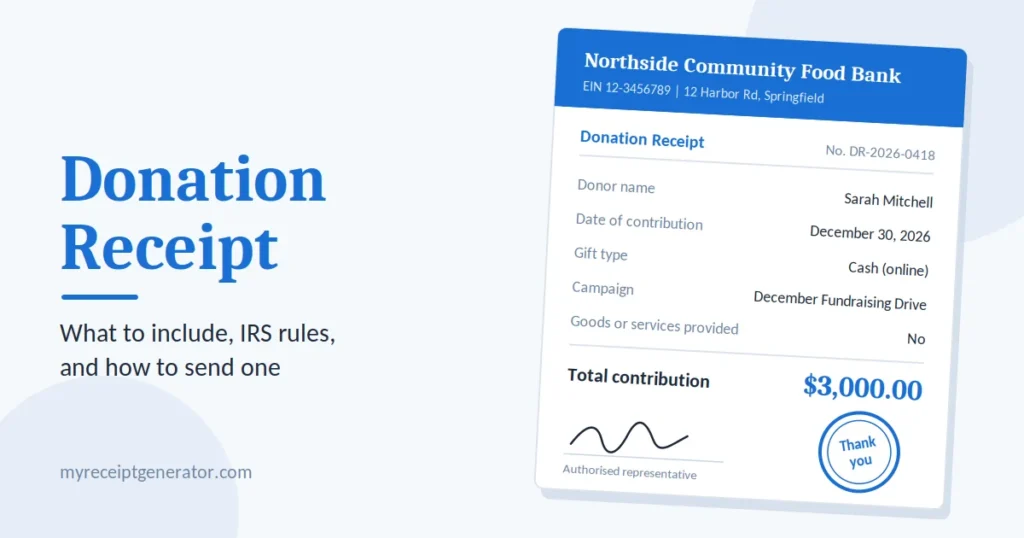
I judge receipt completeness with one test: could a stranger read it and verify the gift without calling anyone? If not, something’s missing. Every receipt needs these elements:
- Charity information, including the legal name, address, and registration or foundation number (in the US, that’s the EIN).
- The donor name and date of contribution.
- The amount of cash contribution, or a description of non-cash gifts.
- A yes or no statement on goods or services provided in exchange, with an estimated value if the answer is yes.
- A signature from an authorised representative, plus organization contact information.
- A summary of the gift details and the total.
One tip I always give: add a unique receipt number to every receipt. It makes tracking and audits far easier, and our free invoice number generator works just as well for receipt numbering.
The IRS sets the written acknowledgement threshold at $250 or more. Below that, a bank record can work for a donor who wants to deduct a single contribution. Above it, the receipt is mandatory. The fair market value of donated items is the donor’s call, so the nonprofit only describes them.
Receipt delivery timing matters just as much as content. For online donations, I aim for under 48 hours. Mailed gifts realistically take 2 to 5 business days once check processing is included.
Then come year-end statements. Send consolidated giving statements in January, well before April, covering every contribution from the previous tax year. They support tax reporting, compliance, accurate records, and cleaner financial documentation.
How a Donation Receipt Works
The flow is simple once it’s set up. A gift posts to your donor database with the donor name, transaction date, amount, and campaign. That record triggers an automated receipt template, which pulls in the gift details and sends an email within minutes.
That email does two jobs: confirming the gift and stating whether any goods or services were exchanged. Finance keeps a copy, so when audits come around, the required elements are already on file, and nobody has to dig.
Take a mid-size food bank with 1,200 active donors running a December fundraising drive. A major donor makes a $3,000 online gift on December 30. The receipt arrives that evening. In January, the food bank sends a year-end giving statement, one consolidated year-end statement listing every gift, ready for tax filing.
No CRM yet? A receipt template or our free receipt maker still gets you professional receipts:
- Download the template and open the PDF.
- Add information for the donor and the gift.
- Send the receipt by email or post.
- Save a copy for your organized records.
If you’re new to building receipts online, our receipt generator guide walks through the full setup. Whichever route you choose, keep the donation process tight. Fast receipt delivery, complete documentation, and a warm acknowledgement cover compliance without adding extra work to your week.
Types of Donation Receipts
Charitable Donation Receipt
A charitable donation receipt is the all-rounder. It covers any donation of cash, goods, or services given to a charity or nonprofit. I usually start here and customise the template for other kinds of donations, because the core contribution fields rarely change.
In-Kind Donation Receipt
An in-kind donation receipt records goods or services donated in place of cash. Describe the non-cash contribution in detail and skip assigning a dollar value. This receipt type trips up more teams than any other.
Cash Donation Receipt
A cash donation receipt is the most common receipt type. It covers any cash donation, including checks and card payments, and states the exact contribution amount along with the date it was received. If you’re receipting a purchase rather than a gift, use a standard cash receipt instead.
Stock Gift Donation Receipt
When individuals or companies donate shares, the organisation issues a stock gift donation receipt. This receipt type lists the company name, number of shares, and transfer date. It doesn’t list a dollar value, because the donor handles valuation.
Silent Auction Receipt
Attendees who purchase items at an auction get a silent auction receipt. Only the amount paid above the item’s fair market value counts as a gift, so this receipt type must show both figures clearly. For regular merchandise sales at your event, a sales receipt is the better fit.
End-of-Year Donation Receipt
An end-of-year donation receipt bundles all contributions from the financial year into one annual summary. Donors appreciate these year-end statements at tax time, because one document is far easier to file than twelve separate emails.
The Bottom Line
A donation receipt is a formal record of a gift, and it supports donor tax deductions and your compliance at once. Timely, accurate receipts build trust, reduce audit risk, and quietly support donor retention year after year.
My advice for any nonprofit organization is simple: standardize receipt templates, automate delivery, and make sure every gift gets a clear, compliant acknowledgement without exceptions.
Frequently Asked Questions
What Is the Purpose of a Donation Receipt?
The purpose is transparency. A detailed donation receipt gives donors proof of contributions and gives the organisation a clear record for financial record-keeping, so staff can track and manage donations properly.
It’s important for tax as well. Keeping donation receipts helps donors meet tax requirements, back up tax deduction claims, or claim tax relief in the UK. Written records support compliance, and the receipt doubles as a formal thank you for what they contributed.
Good donation receipts keep everyone on the same page about what was donated, when, and how much. Accurate paperwork now saves a messy record hunt later.
When Should I Send a Donation Receipt?
Send receipts within 48 hours for online gifts and within a few business days for mailed gifts once processing is done. For one-off donations, send it as soon as possible, with 24 to 48 hours as a realistic target.
If someone makes a regular donation, like a monthly cash sum, one end-of-year donation receipt usually covers tax or tax relief purposes, as long as each payment is listed.
Timely, prompt receipt delivery matters. Fast receipts reinforce donor confidence and protect you when questions come up months later.
What Must a Donation Receipt Include?
At minimum, it needs the donor name, the date of contribution, the amount of cash contribution or a description of non-cash gifts, and a statement on whether goods or services were provided, with their fair market value if so.
A donor needs a written acknowledgment from the charitable organization for any single contribution of $250 or more to claim a deduction. Treat these as minimum requirements. A compliant receipt gives donors the documentation they need at tax filing time.
What’s the Difference Between a Donation Receipt and a Donation Acknowledgment Letter?
A donation receipt exists for tax and compliance purposes. It confirms the date, the amount, and any goods or services the donor received in exchange for the gift.
An acknowledgment letter is a stewardship communication. Its job is to thank the donor properly and share real program impact, such as meals served or families helped.
Most teams I’ve seen send one document with both combined. It reads like a warm letter but still works as a formal record of the gift and proper documentation for the donor and the nonprofit.
How Does a Nonprofit Issue a Receipt for an In-Kind or Non-Cash Gift?
For an in-kind or non-cash gift, the receipt should list the donor name, the date, and a detailed description of the donated items. Leave out any claimed value entirely.
Nonprofits shouldn’t assign a fair market value. The nonprofit should describe the item and document the contribution, while the donor relies on their own documentation to substantiate valuation. For items over $5,000, the donor typically needs a qualified appraisal, as explained in IRS Publication 561.
FAQ: What Should I Include on Year-End Giving Statements?
Solid year-end giving statements list each gift with its date and amount, the total for the year, a note on any goods or services received, and your organization’s contact information.
Distribute these statements in January, so donors have them well before April tax filing. They summarize annual contributions, support tax deductions, and double as documentation for compliance and your own financial records.
What Are the Benefits of Digital vs Paper Receipts?
Digital receipts are easier to organise and search. Saving each one as a PDF means no physical files taking up office space, and nothing gets lost in a drawer.
Paper receipts still matter for older supporters and anyone who wants something tangible. Whether a donation receipt goes out on paper or in digital form often comes down to personal preference.
My take: ask donors paper or digital on the giving form. It costs nothing, helps you meet preferences, and keeps digital as your low-cost default.